
I did a thing.
I gathered a small group of women on Zoom and invited them to talk about how they were really doing.
There wasn’t a complicated agenda or some grand purpose behind it. I wanted it to be organic. I’m not a mental health professional, and I wasn’t trying to be one. I just had an idea and wanted to see what would happen.
It wasn’t like I hadn’t done something similar before—facilitating a group, that is. It had just been a very long time.
Even though I’m a technical writer now, I spent years working as a teacher. I’ve helped lead small-group discussions centered around faith. In my current role, I’ve led discussions and meetings about accessibility, and I’ve helped co-facilitate a pilot course with internal employees.
I’ve realized over the years that I miss interacting with an audience. I love sharing. I love listening. I love creating space for people to talk about things that matter.
And somewhere along the way, that part of me got a little quieter.
Life has changed a lot in the last 10 years. I’ve become a wife and a mother. I’ve carried more responsibilities. I’ve been stretched.
Some of the parts of my life affected by trauma have been exposed. I’ve had to confront the way I respond to conflict. The way I manage stress. The way stress shows up in my body and my mind. Some days, just managing everything I’m carrying from one day to the next feels like a lot.
And apparently, I’m not the only one.
The conversations that started it.
The Exhale was really birthed from about five conversations I had with friends over the course of a week or two.
Different people. Different circumstances.
But there was a common thread.
People were tired.
Mentally tired. Emotionally tired. Carrying things.
And in each conversation, despite the heaviness of what we were talking about, something happened: we seemed to feel a little lighter afterward.
There was relief in simply being honest.
At some point I said to a few of my friends, “We really don’t have many spaces in our everyday lives to talk about our mental health like this.”
Not the polished version.
Not “I’m doing okay.”
The real version.
And it made me wonder: How many other people feel this way?
How many people are struggling but assume nobody else would understand?
What if we just created a space to talk about it?
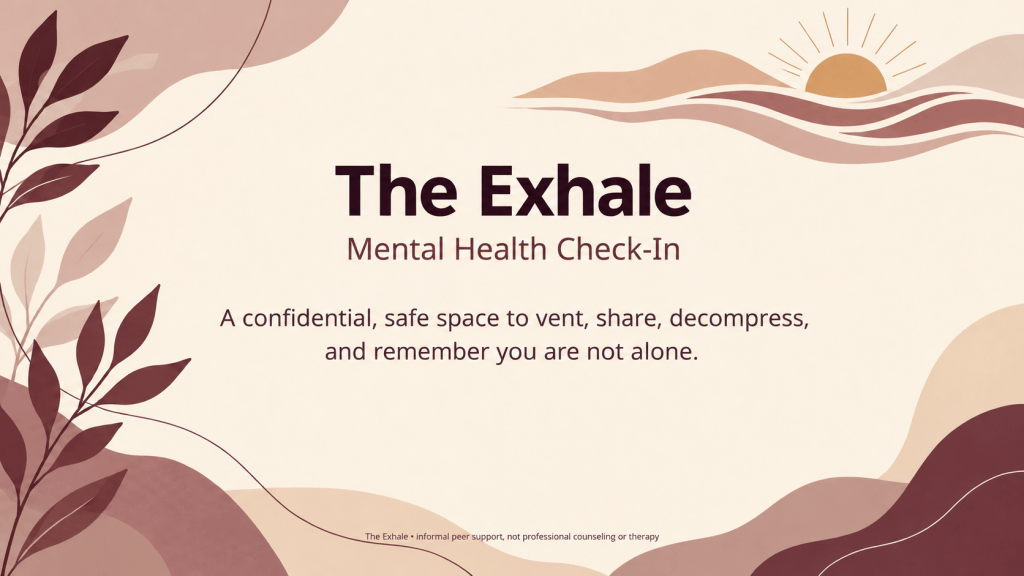
That thought eventually became The Exhale—a virtual mental health check-in where people could come, talk, vent, listen and decompress.
Then Sunday came.
I was nervous.
I wasn’t sure if people would talk. I wasn’t sure how the conversation would flow. I wasn’t sure if my idea would work at all.
But I did it.
We did it.
A small gathering of women came together and talked about some of the things that had been weighing on them.
There were tears.
There were moments when someone’s words clearly connected with something another person had experienced.
And something else happened that I found interesting.
I could feel that some of us wanted to jump in and try to fix each other.
Someone would share something difficult, and almost instinctively, I know some of us wanted to offer a solution.
We had to remind ourselves:
Let her vent.
Let her have this moment.
We don’t have to fix it.
That was harder than I expected.
Maybe because so many of us are used to putting out fires.
In our families.
On our jobs.
In our relationships.
Many of the women on that call are the people others see as having it together. Some work in professions where they are the ones other people come to with their problems, questions and concerns.
But this wasn’t about anybody having it together.
This was our time.
A space where you could show up struggling.
And I could feel how difficult that was for some of us.
Because it’s hard to admit that you’re not okay when you’re accustomed to being the person everyone else depends on.
It’s hard when you’re always jumping in to save somebody else and quietly wondering:
Who is going to show up for me?
I needed it too.
When the session ended, the facilitator in me immediately started evaluating everything.
What should I change next time?
Should the group stay small and intimate?
Should I be more intentional about who is grouped together?
Do we need more structure? Less structure?
There are things I’ll probably change if I do it again.
But my biggest takeaway wasn’t about facilitation.
It was about me.
Over the past year, I’ve been trying to pay closer attention to the things that energize me—the places where I feel like I’m using my voice and operating from my natural strengths.
The Exhale reminded me of something.
I like creating spaces where people can be honest.
I like meaningful conversations.
I like listening to people’s stories.
I like helping people realize that whatever they’re carrying, they may not be carrying it alone.
And somewhere in the process of trying to create that space for somebody else, I realized something else:
I needed it too.
I needed to hear other people say they were tired.
I needed to hear that other people were trying to work through things they hadn’t figured out yet.
I needed the reminder that I’m not the only person out here trying to carry life while simultaneously trying to figure out how to carry it.
Maybe that’s what The Exhale showed me most.
Maybe we don’t always need another person to tell us how to fix our lives.
Maybe sometimes we just need a room—virtual or otherwise—where we can finally admit that life is heavy, hear someone else say, “Me too,” and exhale.


Leave a Reply